
2025: Be Tsunami Ready: Invest in Tsunami Preparedness
To achieve the goal of the Sendai Framework of reducing disaster losses by promoting resilience-building measures that protect lives, livelihoods, and economies from the devastating impacts of tsunamis from all sources, including volcanos, the theme of World Tsunami Awareness Day 2025, on 5 November, is “Be Tsunami Ready: Invest in Tsunami Preparedness”.
Theme of the day: Be Tsunami Ready: Invest in Tsunami Preparedness
The World Tsunami Awareness Day 2025 Campaign is dedicated to advancing tsunami resilience through alignment with the Tsunami Ready Programme, a global initiative aimed at strengthening community resilience through awareness and preparedness strategies.
This campaign seeks to highlight the importance of proactive measures in mitigating tsunami risks, fostering collaboration among all stakeholders – governments, academia, local leaders, and the public to enhance tsunami preparedness.
The theme is to be aligned with the theme of the International Day for Disaster Risk Reduction, on 13 October, and the theme of the 4th International Conference on Financing for Development “Financing Our Future” that happened on 30 June.
Key messages

- Tsunami preparedness is a public good and a sound economic strategy
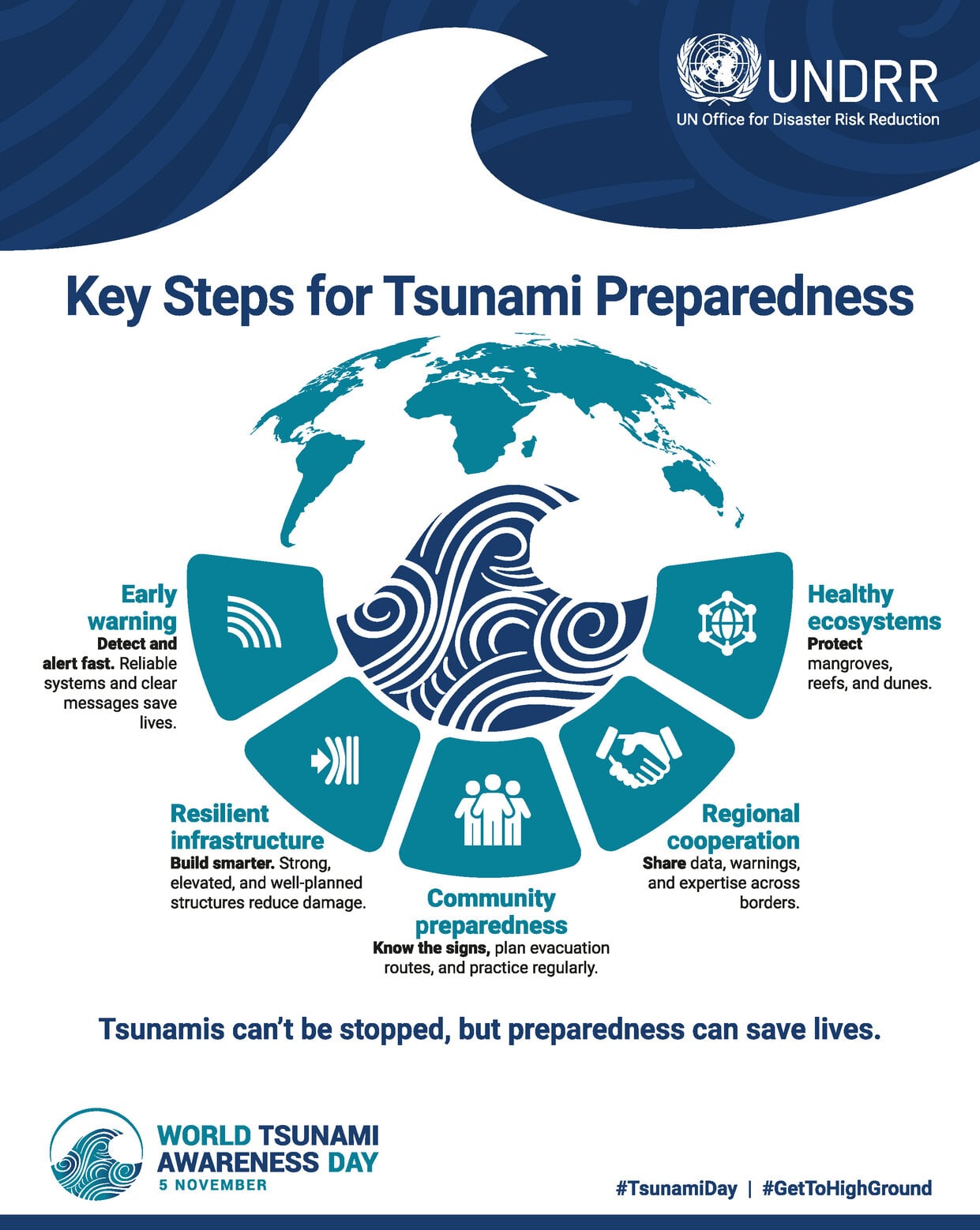
Investments in tsunami early warning, evacuation mapping, risk education, and regular drills reduce mortality, limit disruption, and protect development gains along coasts.
- Regional coherence is key for tsunami early warning
Interoperable, cross-border systems and shared protocols create timely, trusted tsunami alerts and a common operating picture across entire coastlines.
- Financing and innovation for tsunami resilience is necessary
Financing aligned with coastal risk, together with proven and emerging tsunami technologies (e.g., detection networks, inundation modelling, resilient infrastructure), underpins durable coastal economies.
- Tsunami risk communication should be continuous
Because tsunamis are low-frequency, high-impact hazards, sustained public awareness maintains tsunami risk memory, keeps evacuation routes and roles familiar, and supports whole-of-society resilience.
- Tsunami readiness is measurable
A performance-based community framework using tsunami-specific indicators such as accessible public information, routine education activities, and community tsunami drills signals that essential safeguards are in place.
Facts and figures
1) There is a 4 to 36 times return on investment in early warning
Global analysis estimates US$4–36 billion in annual benefits for roughly US$1 billion/year invested in modern early warning, including approx. 23,000 lives saved per year. (World Bank)
2) Universal warnings cut losses by up to 20%
Providing universal access to early warnings (for storms, floods, and tsunamis) can reduce asset losses by up to approx. 20%, preventing about US$13 billion in damage annually. Well‑being gains are even more significant at approximately US$22 billion/year. (WMO)
3) Preparedness education and drills save lives: the “Kamaishi Miracle” (2011)
In Kamaishi City (Japan), only 5 of approx. 2,900 elementary and junior‑high students perished when the tsunami triggered by the Great East Japan earthquake hit. No child at school that day died. This remarkable outcome is widely attributed to sustained tsunami education and frequent evacuation drills, which successfully prepared students to evacuate to higher ground. (GFDRR)
4) Public investment buys evacuation time
After 2011, Japan built approximately 395 km of coastal seawalls at a cost of ¥1.35 trillion (US$12.7B) to delay inundation and increase evacuation time – an example of large‑scale, publicly financed risk‑reduction infrastructure. (Reuters)
Social media resources


