
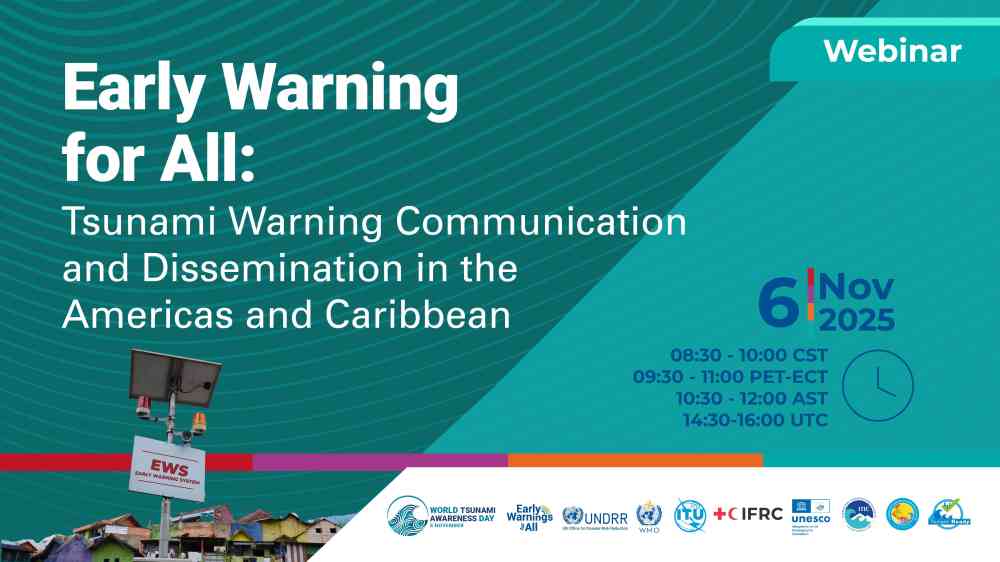
Early Warning for All: Tsunami warning communication and dissemination in the Americas and the Caribbean
- English
- Spanish
Time:
08:30 - 10:00 CST / 09:30 - 11:00 PET-ECT / 10:30 - 12:00 AST / 14:30-16:00 UTC
About
In commemoration of the 2025 World Tsunami Awareness Day with the theme “Be Tsunami Ready: Invest in Tsunami Preparedness” and as part of the Early Warnings for All (EW4ALL) initiative in the Americas and the Caribbean, UNDRR, WMO, ITU and IFRC are partnering with UNESCO-IOC ICG/CARIBE-EWS and ICG/PTWS to hold a virtual dialogue on the overall status, key challenges and possible solutions for strengthening tsunami warning communication and dissemination with a view to advancing people-centered, end-to-end multihazard early warning systems (MHEWS) in the Americas and the Caribbean.
Effective early warning systems are critical to saving lives and reducing disaster impacts, and tsunami warnings are an integral part of the UNESCO-IOC Tsunami Ready Recognition Programme. The success of these systems depends not only on technological capabilities but also on how warnings are communicated and understood by communities. The annual CARIBE WAVE and biannual PACWAVE exercises as well as recent events have provided valuable insights into some of the strengths and gaps in tsunami preparedness, particularly in the communication and dissemination of warnings.
Among other identified challenges, there is a persistent limited use of existent communication and dissemination mechanisms which are operated by National Meteorological and Hydrological Services (NMHSs) in the region such as the WMO Information System WIS 2.0; low-cost satellite communication platforms as GeoNetCast and others. In addition, good practices and progress in place in many countries in the region regarding the implementation of Common Alert Protocol (CAP), are not known or have been enabled for tsunami-related information.
Successful warning and communication systems are critical components of effective tsunami resilience and related preparedness efforts such as the UNESCO-IOC Tsunami Ready Recognition Programme and similar initiatives. All these initiatives contribute to the United Nations Decade of Ocean Science for Sustainable Development (2021-2030), Societal Goal of making 100% of at-risk communities prepared for and resilient to tsunamis by 2030.
Due to the nature of the tsunami hazard, the development of effective tsunami early warning systems have proven fundamental in supporting early warning for other types of hazards and thus contributing to the development of multi-hazard early warning systems to reduce the number of deaths, losses and damages by 2027 as articulated in the United Nations EW4All initiative.
The 2025 World Tsunami Awareness Day (WTAD) Campaign is dedicated to advancing tsunami resilience through increased alignment with the Tsunami Ready Programme, aimed at strengthening community resilience through awareness and preparedness strategies. This campaign seeks to highlight the importance of proactive measures in mitigating tsunami risks, fostering collaboration among all stakeholders – governments, academia, local leaders, and the public – to enhance tsunami preparedness.
The Tsunami Ready Programme is a voluntary initiative that promotes and recognises comprehensive tsunami preparedness at the community level. It encourages coastal communities to adopt mitigation measures that align with a standardized set of indicators. Among these are key outreach elements including a hazard and risk assessment, making public awareness materials widely available, holding regular educational activities, conducting community tsunami drills and means for timely, redundant and actionable warning communication and dissemination. While being recognized as Tsunami Ready does not guarantee immunity from tsunami impacts, it signifies that a community has taken essential steps to minimize potential losses and protect the lives of its residents and visitors.
This webinar aims to build on lessons learned from CARIBEWAVE and the inventory and survey of methods and training needs generated by the ICG/CARIBE-EWS Working Group 3 on Tsunami Warning Communication and Dissemination and foster dialogue among key stakeholders to improve end-to-end, people-centered tsunami warning systems.
Objectives
- Assess the current status of tsunami warning communication and dissemination systems in the region — including WIS 2.0, GeoNetCast and CAP.
- Promote capacity-building through targeted training on the implementation, operation, and effective use of warning communication and dissemination systems.
- Identify key challenges in ensuring timely, understandable, and actionable tsunami warnings.
- Share good practices and innovative solutions from CARIBE WAVE, PACWAVE, recent tsunamis (February 8, 2025 South of Cayman Islands and July 29, 2025 Kamachatka).
- Promote collaboration among technical agencies, emergency managers, and community organizations.
Expected outcomes
- Increased awareness of the importance of end-to-end, people-centered approaches in tsunami warning communication and dissemination systems.
- Strengthened regional collaboration and knowledge exchange.
- Recommendations for improving communication and dissemination strategies and community engagement.